|
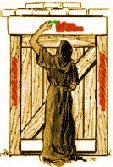
God commanded that on Nisan 10 (Shabbat HaGadol) each head of the household should set aside a young male lamb which should be examined for blemishes which might disqualify it as an offering. Interestingly, this period of time allowed time for each family to become personally attached to their lamb, so that it would no longer simply be "a lamb" (Exod. 12:3) but rather their lamb" (Exod. 12:5). On the afternoon of the Nisan 14 the lambs were to be publicly sacrificed by the "whole assembly" (Exod. 12:6). And even though the entire nation was responsible for the death of the lambs, each family was to apply the blood of their personal lamb upon the doorpost as a sign of their faith in the Lord's deliverance (Exod. 12:7).
The name Pesach (translated Passover) derives from the Hebrew word pasach (passed over) and refers to the sparing of the households of the faithful on account of the sacrificial blood of the lamb:

It is the sacrifice of the LORD's Passover (pesach), for he passed over (pasach) the houses of the people of Israel in Egypt (Exodus 12:27)
That night the meat of the sacrifice was to be roasted with unleavened bread and bitter herbs and eaten in haste, since the Jews were to be ready to begin their journey immediately after God smote the Egyptian firstborn sons. God "passed over" those homes whose doorposts were sprinkled with the blood of the passover lamb. God further commanded that Passover be observed annually as a permanent reminder of the deliverance from Egypt. Only unleavened bread is to be eaten for seven days, and the first and seventh days of Pesach are to be days of holy assembly on which all work is forbidden.
The Observance Of Passover
After the Mashiach Yeshua came, the Temple was destroyed (AD 70) and Rabbinical Judaism eventually assumed leadership of the Jewish people. According to the rabbis, the idea of blood sacrifice was changed to mean "prayer and the performance of mitzvot." The rabbis then decreed that Passover should be commemorated by means of the Passover Seder, held on Nisan 15.
Technically speaking, Passover is a one day holiday that recalls the deliverance of the LORD by means of the blood of the lambs, immediately followed by the seven day Feast of Unleavened Bread (Chag HaMatzot). Modern Judaism, however, considers Passover to be an eight day holiday that remembers the birth of the Jewish people as a nation (and thus conflates Passover proper with Chag HaMatzot). Today Jews celebrate Passover to commemorate the liberation of the descendants of Abraham from their prophesied slavery in Egypt (Gen. 15:13) under the leadership of Moses, but Christians and Messianic Jews also remember the sacrifice of Yeshua the Mashiach as the Lamb of God (seh Elohim) who takes away the sins of the world (John 1:29, 36). This is the real meaning of Passover.
Passover is to be celebrated at the full moon in the first month of the year, namely on the 15th day of the Hebrew month of Nisan (in spring). The English date varies from year to year, sometimes in March/April, based on the Jewish lunar calendar. Note that, like all other holidays, the day begins at sundown, so at twilight on Nisan 14 the holiday technically begins. This agrees with the commandment given in the Torah, "In the first month, from the fourteenth day of the month at evening, you shall eat unleavened bread until the twenty-first day of the month at evening" (Exod. 12:18).
A Second Chance for Passover
Note: A second chance for observing Passover, called Pesach Sheni, was provided for in the Torah (Num. 9:9-12) to accommodate those who are ritually unclean for the seder. This second chance for the seder would occur one month later, on Iyyar 14.
In the Torah, Passover is also called:
- Chag Ha-Aviv - The Spring Festival (Deut. 16:1)
- Chag HaMatzot - The Feast of Unleavened Bread (Exod. 12:17-20)
- Chag HaPesach - The Festival of the Pascal Lamb (Num. 9:2)
Among Rabbinically observant Jews, the liberation of the Jewish people is the keynote of the Passover season, and indeed Passover is often called zeman cheruteinu, the "season of our liberation." Jews remember the redemption of Israel as the herald of the future redemption of all mankind. As such, Passover is a Messianic holiday since the Messiah is the Redeemer of all humanity.
For Messianic Jews, Passover marks the liberation of the entire world from the bondage to the evil one (a type of Pharaoh who enslaves humanity) by the hand of One greater than Moses. Like the original Passover in Egypt, the sacrifice of the Lamb causes the wrath of God to "pass over" those who are trusting in the LORD's provision for redemption, but in the case of the sacrifice of the Mashiach Yeshua, this redemption delivers us from the cruel bondage of Satan and causes the wrath of God to forever be put away from us (baruch HaShem!).
Jewish tradition prescribes a number of rituals associated with the observance of Pesach, including the mitzvah of removing chametz (and abstaining from eating chametz during the seven days of Pesach), the mitzvah of preparing a Seder and reading from the Haggadah (liturgy), the mitzvah of hearing the Song of Songs (Shir HaShirim) read during the Sabbath during Passover week, and the mitzvah of beginning the study of the Hebrew classic Pirkei Avot (Ethics of the Fathers), reading a chapter a week until the festival of Shavu'ot (Pentecost).
The Timeline of Passover
There is a connection between Passover and the Feast of Unleavened Bread that is rooted in the redemptive actions of the LORD God of Israel during the Exodus. According to various Jewish sources, the basic timeline for the seven days of Passover are as follows:
- Nisan 1 - The Start of the Sacred Year
On the first of Nisan, two weeks before the Exodus, the LORD showed Moses the new moon and commenced the divine lunar calendar. This is called Rosh Chodashim.
- Nisan 15 - Passover
Two weeks later, on a Thursday, God was ready to deliver the Israelites from their bondage in Egypt. Earlier that evening the Israelites kept the Passover Seder and sprinkled the blood of the lamb on their doorposts. At the stroke of midnight of Nisan 15 the LORD sent the last of the ten plagues on the Egyptians, killing all their firstborn.This was the breaking point for Pharaoh and Israel was "permitted" to leave Egypt. 600,000 adult males (plus the woman and children and a "mixed multitude") left Egypt and began the journey to Sinai under the leadership of Moses.
- Nisan 18 - Pharaoh Pursues
Three days after the Exodus, and regardless of the plagues and devastation that befell Egypt, Pharaoh mobilized his army and pursued the Jews to bring them back. Perhaps this was the result of Pharoah realizing that the "three-day feast to the LORD" in the wilderness was a permanent escape from his clutches....
- Nisan 20 - Pharaoh traps the Israelites
Pharaoh's army trapped the Jewish people against the Sea of Reeds. The Shekhinah Glory of the LORD intervened and blocked them from attack.
- Nisan 21 - the parting of the Sea
The following day the LORD commanded Moses to order the Israelites to march directly into the waters of the sea. Nachshon ben Aminadav of the tribe of Judah was the first to jump into the sea; the water split, and "the children of Israel walked across on the dry land in the midst of the sea." When the Egyptians attempted to follow after them, the waters rushed back and drowned them. The Israelites celebrated their deliverance with the "Song at the Sea" in praise to the LORD.
Note: For more information about the timeline given in Book of Exodus, see the following Torah portions:
- Shemot
- Va'era
- Bo
- Beshalach
|