|
F

[Note: For additional entries, see the letter P.]
Face

(pah-NEEM) n. sing. pl. constr. Face; Features; Countenance.
Faith

(eh-moo-NAH) n. KEYWORD. Faith. Firmness; Steadiness; Fidelity; Steadfastness (Ex. 17:2. Deut. 32:4). Practically speaking, emunah implies that a person, at the core of their heart, believes in the existence and presence of the One True God.
Faithful Remnant (of Israel)
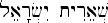
(she-ay-REET yees-rah-AYL) n. Remnant of Israel; descendants of Israel; from the Hebrew ver sha'ar, meaning to remain, survive, to leave behind. The Remnant of Israel is a sovereignly chosen subset of ethnic Israel that has been faithfully preserved by the LORD over the centuries. The Scriptures make a distinction between being an ethnic Jew (i.e., one born Jewish) and one who is considered to be a member of she'arit Yisrael, the faithful remnant of Israel. This can be seen in the following:
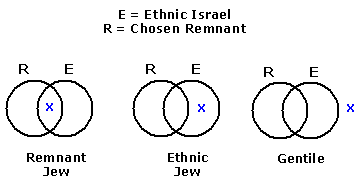
In the New Testament, the metaphor of the Olive Tree (Romans 11) indicates clearly that the Church is incorporated into the remnant of Israel. The Gentile Church must repent regarding its arrogant attitude toward the Jewish people and express profound gratitude to God for their miraculous preservation over the centuries. Moreover, the Gentile Church should stand with ethnic Israel by considering them as "eschatological brethren," that is, future followers and partakers of the LORD Jesus Christ. For "the gifts and calling of God are irrevocable" (Rom. 11:29), and "if their rejection means the reconciliation of the world, what will their acceptance mean but life from the dead? (Rom. 11:15).
The overarching plan of God is to redeem both Jews and Gentiles by means of the unconditional covenants and promises given to the faithful patriarchs of Israel. The Gentile Church does not exist instead of Israel (replacement theology); nor does it exist outside of Israel (separation theology); but rather it is incorporated within the faithful remnant of Israel.
False Prophet

(ne-vee SHE-ker) n. False Prophet; deceiver.
Family

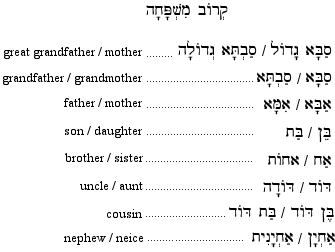
(meesh-pah-KHAH) n. Family; By extension, a close association.
Fast Days

(tsohm) n. Fast; day of affliction. In addition to Yom Kippur, The Talmud (Tractate Rosh Hashana 18b) discusses four fast days (based on Zechariah 8:19) that commemorate the destruction of the First and Second Temples and the exile of the Jewish People from their homeland. In addition, two other fast days are mentioned in the Rabbinical literature, yielding a total of six tzomot (seven if Yom Kippur is included):
- Ta'anit Bechorim - The Fast of the Firstborn is a fast observed only by firstborn males, commemorating the fact that they were saved from the plague of the firstborn in Egypt. It is observed on the day before Pesach (Nisan 14).
- Tzom Tammuz - Fast of the 17th of Tammuz. Fast day commemorating the breaking down of the wall of Jerusalem by Nebuchadnezzar and the cessation of Temple worship during the siege of Titus (Jun/Jul). In the Bible, this is referred to as the Fast of the 4th month.
- Tishah B'Av - The Ninth of Av, a fast day remembering the tragedies of the Jewish people (July/Aug). In the Bible, this is referred to as the Fast of the
5th month.
- Tzom Gedaliah - The fast right after Rosh Hashanah (on Tishri 3) commemorating the murder of the Judean governor Gedaliah by misguided zealots (Sept/Oct). In the Bible, this is referred to as the Fast of the 7th month.
- Yom Kippur - The Day of Atonement (Tishri 10) is the most holy day of the Jewish year. This a fast day where no work of any kind is permitted.
- Asarah B'Tevet - The 10th of Tevet, a fast day commemorating the fall of the Jerusalem. In the State of Israel, Kaddish (the Jewish prayer for the deceased) is recited on this day for people whose date or place of death is unknown (Dec/Jan). In the Bible, this is referred to as the Fast of the 10th month.
- Ta'anit Esther - The Fast of Ester is observed on the day before Purim, on Adar 13 (in Feb/Mar).
Fast of the Firstborn

(ta-a-NEET be-khoh-ROHT) n. The Fast of the Firstborn, Nissan 14, is a fast observed only by firstborn males, commemorating the fact that they were saved from the plague of the firstborn in Egypt. It is observed on the day preceding Passover.
Fast of Ester

(ta-a-NEET ES-ter) n. Fast of Esther. 13th of Adar, the day preceding Purim. The word Ta'anit refers to a fast day or tzom.
Fast of the 17th Tamuz

(shev-ah ah-sahr be-ta-MOOZ) n. 17th of Tamuz. A fast day (tzom) commemorating the breaking down of the wall of Jerusalem by Nebuchadnezzar and the cessation of Temple worship during the siege of Titus.
Father, Son, and Holy Spirit

(hash-shee-LOOSH hak-ka-DOHSH) n. The Holy Trinity. The Tri-une nature of the echad nature of Adonai. See the Names of God.
Fear of the LORD

(yeer-AT Adonai) n. The fear of the LORD; awe and respect shown to God. Reverence shown to the LORD God of Israel.
Feast / Festival

(khag) n. Jewish Festival, Feast, or holiday (see the Jewish calendar for a list of the chaggim).
Feast of Firstfruits

(khag hab-beek-koo-REEM) n. "The Festival of the Firstfruits (בִּכּוּרִים)" or "Chag Shavuot" (the Feast of Weeks). Shavuot (or "Pentecost") is a festival that marks the end of counting of the omer sheaves (sefirat ha'omer) that began on the second evening of Passover (called Yom Habikkurim, or the "Day of Firstfruits" which symbolized the resurrection of the Messiah Yeshua from the dead). The 49 period of time that bridged the first barley and first wheat harvests required sample offerings from the harvests to the LORD at the Temple. Note that Chag Habikkurim is associated with Shavuot and the giving of the Torah as well. The sages determined the day of Shavuot occured on the 6th day of Sivan, 50 days after the Passover from Egypt, and this marked the time when the Israelites received the Ten Commandments at Mount Sinai. Thus, Shavuot became the festival of mattan Torah, the reception of Torah. For more on this see the Shavuot pages.
Feast of Ingathering

(khag ha-a-SEEF) n. Festival of Ingathering. Fall festival; Also referred to as Chag Ha-Sukkot (Feast of Tabernacles).
Feast of Tabernacles

(khag ha-sook-KOHT) n. Feast of Tabernacles. Feast of Booths. Sukkot. Fall festival; celebrating the forty years when the people of Israel lived in booths or tents in the desert. Sukkot is one of three pilgrim festivals when Jews were expected to go up to Jerusalem.
 |
Feast of Unleavened Bread

(khag ham-matz-TZOHT) n. Feast of Unleavened Bread. Directly following Passover is Chag HaMatzot, or the Festival of Unleavened Bread, when no chametz may be eaten or possessed for a full seven days.
Since the Jewish calendar reckons the start of a day at evening, it is sometimes confusing determining when a festival begins and ends. For example, Passover begins on Nisan 14 at evening, that is, between 3:00 pm to sundown, and continues through Nisan 15. Strictly speaking, then, Passover begins on Nisan 14th and ends on Nisan 15th.
In Exodus chapter 12:15-20 God instructed the Jews to eat unleavened bread for seven days, from Nisan 14th at evening until Nisan 21 at evening, but in Leviticus 23:6 the seven day festival of Unleavened Bread is said to begin on Nisan 15, following Passover, and therefore would end on Nisan 22. This apparent inconsistency is reconciled once we understand that the new day begins at sundown, that is, when the end of one day and the start of a new day both occur.
The Festival of Unleavened Bread, then, begins on the 15th of Nisan, which is also a High Sabbath day, and ends on Nisan 22. Chag HaMatzot represents a holy week spent without leaven in our lives, a picture of our response to the redemption of the LORD (Matthew 16:12; Mark 8:14-15; Luke 12:1; Romans 6:13-22; 1 Corinthians 5:6-8).
Note that in modern Judaism, Passover and Chag HaMatzot are collectively considered as a single holiday, usually referred together as "Passover."
Feast of Weeks

(shah-voo-OHT) n. Shavuot; Pentecost; Feast of Weeks; Weeks. The Festival commemorating giving of the Torah at Har Sinai to Israel. Observed on the fiftieth day after the first day of Pesach. Shavu'ot is the concluding festival of the Spring season, a festival of the offering of the first fruits, and a picture of the resurrection of Yeshua the Messiah as the Firstfruits (1 Cor. 15:20).
Feasts of the LORD

(mo-'ED / mo-a-DEEM) n. pl. Feasts; appointed times. See the Jewish calendar for a list of mo'adim. The customary greeting during a feast is Chag Same'ach (Joyful Feast!).
The mo'edim are as follows:
Weekly Mo'edim:
Monthly Mo'edim:
Springtime Mo'edim:
- Abib/Nisan 1: The Biblical Rosh HaShanah
- Shabbat HaGadol: the first Shabbat of the year
- Pesach (Passover)
- Chag Matzah (Feast of Unleavened Bread)
- Yom HaBikkurim (Day of First Fruits)
- Shavuot (Feast of Weeks)
Falltime Mo'edim:
- Yom Teruah (Day of Blowing/Shouting)
- Yom Kippur (Day of Covering/Atonement)
- Sukkot (Tabernacles)
Wintertime Mo'edim
- Chanukah (Dedication)
- Purim (Lots)
Rabbinic Judaism has established several other mo'edim, including:
- Fast of Esther
- Fast of the 17th of Tammuz
- Lag B'Omer
- Tish'ah B'Av
- Tu B'Av
- Tu BiSh'vat
- Tzom Gedaliah
- Yom Ha'atzma-ut
- Yom HaShoah
- Yom HaZikaron
- Yom Yerushalayim
Feeding the Hungry
(ha'a-kha-lat re-ay-VEEM) phr. Feeding the hungry.
Fence (around the Torah)

(see-yag la-toh-RAH) phr. "A fence around the Torah," taken from Pirke Avot 1:1: "Moses received the Torah from Sinai and conveyed it to Joshua; Joshua [conveyed it] to the Elders; the Elders [conveyed it] to the Prophets; and the Prophets [conveyed it] to the Men of the Great Assembly. They said three things: "Be deliberate in judgment; develop many disciples; and make a fence for the Torah (סִיָג לַתּוֹרָה)." The idea of the "fence" comes from rabbinical reflection on nazirite vow, which forbade the nazir to drink fermented drink, but went beyond this restriction to forbid eating grapes or even raisins.
Fey

(FAY) n. Fey. The 17th letter of the Hebrew alphabet having a "f" as in food sound (with a dagesh, "p" as in park). Originally represented by a pictograph meaning "mouth," "work," or "speech." Gematria = 80. Fey also has a sofit (final) form.
Five books of Moses

(TO-rah) / (KHOO-mahsh) n. Chumash; Pentateuch; Torah; the first five books of Moses, usually bound in a codex (book) form and accompanied with Rashi commentary. These books include:
- Bereshit (Genesis)
- Shemot (Exodus)
- Vayikra (Leviticus)
- BaMidbar (Numbers)
- Devarim (Deuteronomy)
Fleece (of sheep)

(ray-sheet GAYZ) n. Reishit HaGez is the giving to the Kohen (priest) the first cuttings of the fleece of sheep grown in the Land of Israel (based on Deut. 18:4). Most Jews cannot perform the mitzvah of giving Reishit HaGez (wool shearings) to a Kohen because they don't own sheep. The same is true with regards to giving the zeroa, lechayayim and keiva (foreleg, cheeks and stomach) to a Kohen (Deut. 18:3).
Footsteps of the Messiah
(eek-VOHT me-shee-KHA) n. Prelude to the Messiah. "Footsteps of the Messiah." The time appointed by God for the Messianic redemption. The Time Immediately Before Mashiach. The term comes from Psalm 89:51.
According to traditional Jewish sources (Pesachim 54b; Midrash Tehilim 9:2), no one knows the time when the Messiah will appear. This accords with the teachings of Jesus and His apostolic witnesses (Matt. 24:36-44; 1 Thess 5:1-3; 2 Pet. 3:10; Rev. 3:3). The condition of the world during acharit hayamim (the end of days) will be grossly evil (2 Pet. 3:3; 2 Thess. 2:3-4, 2 Tim. 3:1-5). The world will undergo various forms of tribulation, called chevlei Mashiach - the birthpangs of Mashiach (Sanhedrin 98a; Bereshit Rabba 42:4, Matt. 24:8). The Zohar (Zohar II:8a) notes that during this time there will be prosperity, technological discoveries and advances, propagation of mystical teachings, and many signs and miracles. This also accords with the teachings of the Brit Chadashah (i.e., the Olivet Discourse of Matt. 24-25).
Forbidden

(ah-SOOR) adj. The word asur (אָסוּר) literally means "bound," but it has come to be used to mean "forbidden" or "prohibited" in halachic discussions. The word mutar (מֻתָּר) is an antonym which implies the freedom or permission to do something. For example, the presence of blood spots found in eggs raises the question of whether they are "asur or mutar" for consumption in light of the laws of kashrut.
Forbidden Fruits

((ohr-lah) n. A forbidden fruit from a newly planted fruit tree. The Torah commands that if you plant a fruit tree you may not eat any of its fruits for the first three years (Lev 19:23), and on the fourth year, all the fruit must be either brought to the Temple (as a sacrifice) or sold and the money given to the Temple. The first years fruit of a tree is holy and belongs exclusively to the LORD. It is regarded as "muktzeh" -- separated from us.
Forbidden Mixtures

(keel-AH-yeem) n. A forbidden mixture, such as mixing two kinds of crops in the same field, or allowing cattle to interbred (Lev. 19:19). Even clothing was required to be pure and free from admixture. Shaatnez (the mixing of wool and other fibers) is sometimes considered to be a metaphor against mingling the holy and the profane. Wool blankets, sweaters, pants, women's apparel, linen suits, blouses, etc., may not be composed of shaatnez.
Forgiveness

(se-lee-KHAH / se-lee-KHOHT) n. Forgiveness; esp. forgiveness by God. Forgiveness is obtained by exercising emunah in the sacrifice of Yeshua as the kapparah for your sins, and by evidencing wholehearted teshuvah or repentance in one's daily life. Selichot (pl) are prayers for forgiveness, esp. said during the "Days of Awe," from Rosh Hashanah to Yom Kippur.

(kap-pah-RAH) n. Atonement. Forgiveness. A Yom Kippur custom is based on the idea of ransom, one life for another. After reciting from the Book of Job (33:23-24), a rooster (for men) or a hen (for women) is swung three times over the heads of the penitent and the following is said: "This is my exchange, this is my kapparah. This rooster is going to be killed, and I shall be admitted and allowed to a long, happy and peaceful life."
Former Prophets

(ne-vee-eem a-kha-roh-NEEM) n. Former Prophets. Joshua, Judges, Samuel, and Kings. Part of the Nevi'im of the Tanakh:
- Yehoshua (Joshua)
- Shof'tim (Judges)
- Shemu'el Alef/Bet (1st/2nd Samuel)
- Melakhim Aleph/Bet (1st/2nd Kings)
Foundation Stone

(E-ven ha-she-tee-YAH) n. "The Foundation Stone." The bedrock at Mount Moriah is called Even ha-Shetiyah (אבן השתייה), "the Foundation Stone," referring to the creation of the earth on the First Day (Isa. 28:16). This is also the name of the rock at the heart of the Dome of the Rock in Jerusalem. The rock is located towards the center of the Temple Mount, an artificial platform built by Herod the Great on top of vaults over a hill, generally believed to be Mount Moriah.
Four Corners

(ahr-ba kan-FOHT) n. phr. "Four corners"; Tallit Katan; worn under an upper garment throughout the day; Tzitzit.
Four Matriarchs
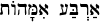
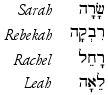
(ahr-ba eem-mah-HOHT) n. The four matriarchs of Judaism: Sarah, Rebekah, Rachel (with Bilhah), Leah (with Zilpah). The Four Matriarchs and zekhut imahot (the merit of the mothers) is sometimes incorporated into Jewish liturgy (i.e., reconstructed first blessing of the Amidah).
Four Questions

(mah neesh-ta-nah) n. "Why (is this night) different (from all other nights)?" Four Questions asked at a Passover seder, traditionally asked by the youngest child at the outset of a Passover Seder, and used by the Passover host as a prompt to explain the significance of the Exodus from Egypt.
Four Sons

(ar-bah-ah vah-NEEM) n. The story of the "Four Sons" is read at the Passover seder (during the Maggid section). Each of the four sons symbolizes a different type of Jew and their relationship with the Torah:
- The wise son (chakham) inquires about why the Jews practice the customs of Passover. The seder leader describes this son as wise, since he wants to know more about the traditions of his people. The seder is for him!
- The wicked son (rasha') wants no part of the Passover traditions and asks why the Jewish people - other than him - practice the customs of Passover. The seder leader responds by describing this son as wicked, since he thinks Passover customs are meant to be observed by other Jews, but not him. He's a hypocrite.
- The simple son (tam) is somewhat bewildered by the Passover Seder and its rituals. The seder leader responds by admonishing him about God's favor toward the Jews during the time of their slavery in Egypt and why it is important to remember God's salvation with gratitude.
- The son who does not know enough to ask (she'eilo yodea lishol) is simply told about the Passover story in accordance with the biblical command: "And thou shalt tell thy son in that day, saying: it is because of that which the Lord did for me when I came forth out of Egypt" (Exodus 13:8). Sadly, most secular Jews today are like this son.
The story of the Four Sons is intended to commend the wise son and to encourage us to remember the Jewish roots of our faith. We must study Torah and respect the Jewish way of life, for if we neglect this we have failed in our responsibility to our heritage. The wise son understands the importance of his heritage and sees it as a means of preserving the knowledge of the LORD God of Israel for posterity.
Four Species

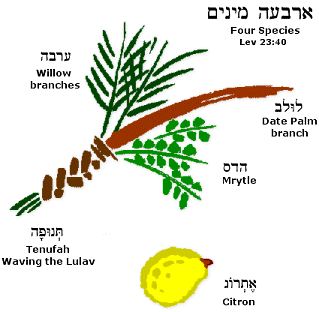
(ahr-ba mee-NEEM) n. Also arba'at ha-minim (אַרְבַּעַת הַמִּינִים). The "Four Kinds or Types of agricultural produce commanded by the Torah to be held together and waved in all directions during Sukkot. The Four Kinds are:
- The Etrog - the citron fruit
- The Lulav - the branch of the date palm
- Hadasim - three myrtle twigs
- Aravot - two willow branches.
Freedom

(khay-ROOT) n. Freedom; liberty; Passover (Pesach) is called chag haCheirut - the Festival of Freedom or Redemption. Zman Cheruteinu is the season of our freedom (Passover). The Hebrew word chofesh (חפֵשׁ) connotes freedom from external restraints, or the freedom to "do your own thing." The word cherut (חֵרוּת), on the other hand, suggests freedom to do what you should, or the freedom to act responsibly. In other words, Passover redemption leads to liberty to serve God, not indiscriminate freedom to act according to whim or impulse.
Free People

(am khohf-SHEE) n. A free people. Chofshi means free (chofshit in the feminine gender). Chofesh hadibur means freedom of speech; Chofesh means freedom.
Free Will

(be-khi-rah khof-sheet) n. Free will; also transliterated as bechira chofshit. The doctrine that the human will is able to choose between alternative possibilities of action in accordance with the inner motives and ideals of the agent. According to the Jewish sages, God foresees everything yet humans have free choice - and therefore responsibility (this is a form of theological compatibilism). For example, Rabbi Akiva is reported to have said: "Though everything is foreseen by God, yet free will is granted to man" (Avot 3:19). Bechirah Chofshit is considered a basic principle of Judaism, a starting point for the doctrine of earning merit before Heaven.
Friend of Israel

(oh-hev yis-rah-AYL) n. Friend of Israel. Ohev Yisrael means one who loves or cherishes Israel or the Jewish people.
Friendship

(ye-dee-DOOT) n. Friendship. Keren Yedidut (Friendship Foundation), a Christian philanthropic agency, helps Jews from around the world to make aliyah to the land of Israel. A yedidut grant is often a sum of money (such as a scholarship) to help students study in Israel. Mah Yedidut (What Friendship!) is a Shabbat table song.
Friendship (middah)

(dee-BOOK kha-vay-REEM) n. "Cleaving to friends" One of the forty-eight virtues (middot) listed in Pirkei Avot. The word "dibbuk´ comes from the Hebrew root Dalet-Bet-Koof meaning "to cling, be attached, glued."
From Strength to Strength
(me-KHAI-yeel el - KHAI-yeel) Biblical phrase: "From strength to strength" (Psalm 84:7). This is a customary phrase of blessing sometimes said on momentius occasions.
Frontlets

(te-fee-LEEN) n. Tefillin; "Phylacteries"; two black leather boxes containing scrolls with Bible passages on them (Ex. 13:1–16; Deut. 6:4–9, 11:13–21). During synagogue prayers men affix one to their hand and arm and the other to their forehead, in obedience to Deut. 6:8. For more information, click here.
Note: The Greek word τὰ φυλακτήρια was transliterated as "phylacteries" by translators of the English New Testament. It does not appear in the LXX (Septuagint) but the word ἀσαλευτόν does, which was used to translate the Hebrew word "totafot" (frontlets) in the verse "And it shall be for a token upon thine hand, and for frontlets between thine eyes (לְטוֹטָפת בֵּין עֵינֶיךָ): for by strength of hand the LORD brought us forth out of Egypt" (Exod 13:16).
The word "tefillin" is probably Aramaic, not Hebrew, though it is obviously related to the Hebrew word "tefillah " (prayer). The word tefillin does not occur in the Torah itself, but rather in the Oral Torah and traditions of the sages/rabbis. The idea that "totafot between your eyes" (Exod. 13:9, 6, Shema: Deut. 6:8, 11:18) refers to the elaborate rules and ceremonies attached to modern tefillin usage is a rabbinical invention. Metaphorically, of course, the idea of totafot means practicing the Presence of the LORD in every moment of our day…
Jesus said, "But they do all their deeds to be noticed by men; for they broaden their phylacteries and lengthen the tassels of their garments" (Matt. 23:5). Most likely this was intended to be a warning that one shouldn't affect religiosity before men in a vain attempt "to be seen" as righteous/zealous.
Fruit of the Spirit

(pe-ree ha-ROO-akh) n. "But the fruit of the Spirit (פְּרִי הָרוּחַ) is love, joy, peace, long-suffering, generosity, acts of kindness, faithfulness, humility, and modesty – against such there is no Torah" (Gal. 5:22-23).
The Fruit of the Spirit are those middot hav-lev (qualities of heart) derived from the power of the Ruach Ha-Kodesh (Holy Spirit) working within the heart of faith. The priot (fruits) listed in Galatians 5:22-23 represent nine visible attributes of a true follower of Yeshua (Jesus):
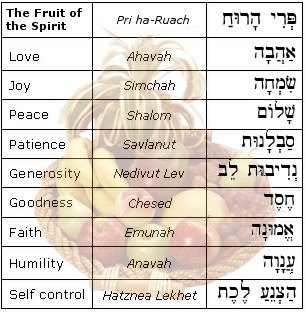
Comments:
Traditional Judaism identifies various middot ha-lev (qualities of heart) that mark a genuinely Jewish life. These include "Talmud Torah" (studying Scripture), "ahavat HaShem" (loving God), "gemilut chasidim" (doing works of righteousness), "bikkur cholim" (visiting the sick), and so on. Similarly, the follower of Yeshua likewise must evidence middot hav-lev, though the Source for such comes directly from the power of the Ruach Ha-Kodesh (Holy Spirit) working within the heart of faith. The fruit of the Spirit are the effects of the agency of the Holy Spirit (רוּחַ הַקּדֶשׁ) within our lives:
- Love (אַהֲבָה) – The Greek word here is agape (ἀγάπη) and most likely refers to love to be given to other people (since the preceding list of vices of the flesh relate to others), though of course loving God is the primary obligation of life: Hear, O Israel... love the LORD your God with all your being" (Deut. 6:4-6). The Apostle later states that love is the fulfillment of the Torah: "For the whole law is fulfilled in one word: "You shall love your neighbor as yourself" (Gal. 5:14). "Owe no one anything, except to love each other, for the one who loves another has fulfilled the law (Rom. 13:8). This is the "kingdom law" (νόμον βασιλικὸν) mentioned in James 2:8.
- Joy (שִׂמְחָה) – The Greek word is chara (χαρὰ), a word related to "grace" (χάρις), which is the expression of thankfulness for being forgiven and accepted by God. A characteristic mark of the grace of God, then, is an inward sense of joy, regardless of circumstances;
- Peace (שָׁלוֹם) - The Greek word is erene (εἰρήνη), though the Hebrew word "shalom" means more than the absence of strife, but also includes the idea of wholeness, health, balance. Peace is also the term describing the relationship between a believer and God in light of the cross of Yeshua;
- Long-suffering (ארֶךְ אַפַּיִם) – The Greek word is makrothumia (μακροθυμία) which comes from "macros" (μακρός), "great," and "thuo" (θύω), "sacrifice"; whereas the Hebrew phrase means "long of nose," an idiom used to describe someone who is patient and slow to anger;
- Generosity (נְדִיבוּת) – The Greek word is krestotes (χρηστότης), which may refer to the disposition of grace that is expressed in mildness and kindness toward others; in Hebrew nedivut means "generosity," and nedivut lev means having a generous heart (a nedavah is a "free-will" offering or donation from the heart);
- Goodness (גְּמִילוּת חֲסָדִים) – The Greek word is agathosune (ἀγαθωσύνη); this refers to acts of chesed, lovingkindness, that are esteemed as "good" in the eyes of God. Gemilut chasidim (גְּמִילוּת חֲסָדִים) means "the bestowal of kindnesses," or the practice of chesed (i.e., love). Such benevolence is regarded as greater than tzedakah (doing the right thing out of a sense of duty) because love anticipates the needs of others and acts from a sense of compassion. As an old Jewish proverb states: "Tzedakah awaits the cry of distress; benevolence anticipates the cry of distress."
- Faithfulness (אֱמוּנָה) - The Greek word used is pistis (πίστις) which is connected with integrity of heart that induces a sense of trustworthiness in a person (as in a "faithful friend," "a faithful spouse," etc.). As such, faithfulness is associated with the truth ("emet"), implying reliability; trustworthiness, etc.;
- Humility (עֲנָוָה) - The Hebrew word anavah implies a sense of inner poverty that can only be healed by giving and serving others. "Blessed are the poor in spirit." The Greek word praotes (πρᾳότης) indicates courtesy and an "other-regarding" focus that honors others and esteems them as better than yourself;
- Modesty (צְנִיעוּת) – The Greek word engkratea (ἐγκράτεια) literally means "inner strength" (from εν-, "in" + κράτος, "strength" or "power") refering to the power of the indwelling Spirit. The Hebrew word suggests hiding of the flesh or the covering of the body, though the Greek word indicates an inner strength given by God to choose the good.
If there is no seed, there is no fruit; and the type of seed always determines the type of fruit (1 Pet. 1:23; 1 John 3:9). We can sow to the flesh – and reap corruption, or we can sow to the Spirit, and reap life everlasting (Gal 6:7-8). Therefore the formation of "Messiah-like character" is the result of disciple (παιδεία), a word that means to instruct or rear a child (παιδεύω). Indeed, in some cases the word can mean to "whip" or "scourge" someone in punishment. In Hebrew, the word is musar (מוּסָר) which is related to the idea of moral instruction and guidance which is intended to inculcate Jewish values and the "fruit of righteousness" (פְּרִי לִצְדָקָה).
Note that Hebrews 12:11 says the the peaceful "fruit of righteousness" (פְּרִי לִצְדָקָה) is found in its "exercise," a word (gumnadzo: γυμνάζω) used to refer to training for competitive sporting events. Of course the flesh will "grieve" and lament over such the exercise of such restraint, but the end result will be a heart of peace that produces the fruit of righteousness...
It is important to remember that this fruit is not obtained through self-effort or human reformation, but rather is a supernatural outgrowth of the grace and love of God in the life of one who puts their trust in Yeshua as Mashiach. See John 15:1-8.
|