|
O

Obadiah

(oh-VAHD-yah) n. Obadiah; Shortest of the prophetic books in the Neviim of the Tanakh. Ovadyah means "servant of Adonai."
Ohel Moed

(oh-hel moh-ED) n. Tent of Meeting. Also called the Mishkan or Tabernacle. Ohel means tent.
Ohev Yisrael

(oh-hev yis-rah-AYL) n. Friend of Israel. Ohev Yisrael means one who loves or cherishes Israel or the Jewish people. A christian who stands with Israel, who prays for Israel and the peace of Jerusalem is rightly called ohev Yisrael.
Ohr Emet

(ohr E-met) n. True Light; a title for the Messiah (John 1:9).
Ohr Ha'olam

(ohr ha-oh-LAHM) n. Light of the world. A title for Yeshua the Messiah (John 8:12).
Ohr HaChayim

(ohr ha-KHAI-yeem) n. The light of life (John 8:12), a promise that the talmidim of Yeshua would experience His Light.
Olah

(oh-LAH) n. "Ascending [offering]." Whole burnt offering, in which the entire animal ascends to smoke (the plural is olot (עוֹלת)). This was a nedavah (freewill) sacrifice that was consumed entirely by the fire on the altar. The sacrificial victim must be an animal or a bird that is without defect. As the animal is slaughtered, the kohen catches its blood in a pan and sprinkles it (zerikat hadam) on the altar. The animal is then cut up, salted, and entirely burned. Normally, semichah (leaning of the hands on the head of the animal) and viduy (confession of sin) accompanies this sacrifice (though in the case of a bird olah, semichah is not performed). This parashah adds that Olah sacrifices must only be offered during daylight hours and must burn through the night. The kohanim, therefore, needed to be present at the mishkan around the clock, tending to the sacrifices and ensuring that the fire for the mizbeach (altar) would never go out.
Olam

(oh-LAHM) n. Eternity; world. Also: everlastingness.
Olam Ha'amet

(oh-lahm ha-a-MET) n. The world to come, in which truth will prevail. A synonym for Olam Habah.
Olam Habbah

(oh-lahm hab-BAH) n. phr. The world to come. The "World-to-Come"; the place of Reward for the Righteous. This term is also used to refer to the Messianic Age. Also transliterated as "Olam Habah," or "Olam ha-ba."
Olam Hasheker

(oh-lahm ha-SHE-ker) n. phr. The false age; the illusory world. Olam Hasheker can refer to the illusory state of perception in this world or it can refer to the evil of the political world system itself.
Olam Hazeh

(oh-lahm haz-ZEH) n. phr. This present age; this world. The time between Adam's fall and the coming of Mashiach. According to the Sages the Olam Hazzh will endure for 6000 years from the time of the impartation of the neshamah to Adam in Gan Eden. Also transliterated as Olam Hazzeh.
Olam Malei

(oh-lahm mah-LAY) n. phr. "A complete world," a "full" world; referring to the individual soul created by God. God created Adam alone as "olam malei" (עוֹלָם מָלֵא), an entire world, to teach us that each individual person is of great value and significance. "Thus anyone who sustains one individual has sustained the world; and anyone who destroys one individual has destroyed an entire world."
Old Testament

(be-REET ye-shah-NAH) n. "Old Testament" is the Christian term for the Jewish Scriptures. The word "testament" comes from the Latin word for will (as in last will and testament) and derives from the Greek word diatheke, which means covenant. The translators chose the word "testament" because God's covenant (like a will) is unilateral. The term comes from 2 Corinthians 3:14, where Rav Sha'ul refers to the old covenant. Note: It is better to use the acronym Tanakh among practitioners of Judaism and "former covenant" among Messianic believers.
Oleh / Olim
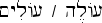
(oh-leh / oh-LEEM) n. Immigrant to Israel (lit. "one who ascends"). Plural is olim.
Omer

(OH-mer) n. Omer (measure of grain). A dry measure spoken of in Torah of the barley that was brought as an offering on the second day of Pesach -- Nisan 16 -- after which then the grain of the new harvest was permitted to be eaten. The 49 day period of counting from the time of this offering until the Festival of Shavuot, the 50th day, is called counting the Omer (these days are counted on an omer calendar).

Ometz Lev

(OH-metz layv) n. Courage (of heart); boldness.
Ona'at Devarim
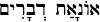
(oh-nah-at de-vah-REEM) n. (אוֹנָאַת דְבָרִים) Verbal abuse; hurting another person's feelings by means of the malicious use of words (such as teasing, annoying, name-calling, venomous speech, and so on). The sin of deliberately hurting another person's feelings. The sages interpret the commandment, "You shall not wrong one another, but you shall fear your God" (Lev. 25:17) as "You should not hurt the feelings of one another, and you shall fear the Almighty." One who publicly embarrasses another so the person's color changes (i.e., either blushes or turns ashen) is judged as if he spilled blood. Unlike physical damages or loss, the Pele Yoetz states that there is no way to repair the damage of ona'at devarim: the wounds often fester in the mind for a lifetime. Also spelled ona'as devarim.
One New Man

(eesh-e-khad khah-DASH) n. "One new man." k'ish echad, b'lev echad means "like a single person with a single heart," though the Brit Chadashah goes beyond Rashi to point to a true, eternal identity. See Eph. 2:15; John 17.
Oneg

(OH-neg) n. Oneg. Pleasure; Delight; Party.
Oneg Shabbat

(OH-neg shab-BAHT) n. Shabbat party. The informal gathering for conversation and community after Sabbath services. Hebrew for "joy of the Sabbath."
Optimism

(gam zoo le-toh-VAH) phr. "This too, is for the best." From a story in the Talmud of a sage named Nachum, whose staunch faith in God led him to declare all of God's actions as being for the best. His name therefore became Nachum Ish Gam Zu, Nachum, the Man of 'Everything is for the Best.' (Note: gamzu is an abbreviation for the phrase.) An old saying: "The optimist believes this is the best of all possible worlds, and the pessimist is afraid that the optimist is correct."
Orakh Chayim

(oh-rakh KHIE-yeem) n. The path of life; also spelled as Orach Chayim. A section of Rabbi Jacob ben Asher's compilation of Halakha (Jewish law) that deals with aspects of the Jewish calendar and mo'edim. In the Scriptures, Orakh Chayim refers to the path of obedience to the Torah and commandments of Adonai. The phrase itself occurs in Psalm 16:11, Prov. 5:6 and 15:24. Ultimately the path of life leads to obedience to the Mashiach Yeshua, who is the way, the truth, and the life (John 14:6).
Oral Law

(toh-rah sheb-AL peh) n. Oral Torah; Talmud. Tradition reports that the two forms of Torah, Torah she-bikhtav and Torah she-be'al peh, have existed side by side ever since the revelation at Har Sinai. The Oral Torah, which was not committed to writing during the centuries preceding the compilation of the Mishnah, was transmitted orally by a chain of sages and carriers of tradition. Karaites reject all Oral Torah (as do Christians, of course).
Orchot Tzaddikim
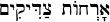
(oh-re-KHOT tsad-dee-KEEM) n. Orechot Tzaddikim (the Paths of the Righteous) is a book on Jewish ethics written in Germany in the 15th century, entitled Sefer ha-Middot (the Book of Qualities) by the author, but later renamed by a copyist. A sample statement from the book reads: "It is evil pride to despise others, and to regard one's own opinion as the best, since such an attitude bars progress, while egotism increases bitterness toward others and decreases thine own capability of improvement." The aphoristic style includes statements such as: "Forget not the good qualities thou lackest, and note thy faults; but forget the good that thou hast done, and the injuries thou hast received."
Ordination

(se-mee-KHAH) n. Semichah. 1) Laying on our hands (upon the head of the sacrifice); 2) Ordination (as of a Rabbi).
Orlah

(ohr-lah) n. A forbidden fruit from a newly planted fruit tree. The Torah commands that if you plant a fruit tree you may not eat any of its fruits for the first three years (Lev 19:23), and on the fourth year, all the fruit must be either brought to the Temple (as a sacrifice) or sold and the money given to the Temple. The first years fruit of a tree is holy and belongs exclusively to the LORD. It is regarded as "muktzeh" -- separated from us.
Orthodox (Judaism)

(dah-tee) n./adj. An Orthodox Jew is one who believes that all of Jewish law is binding. Orthodox Judaism (includes Hasidic Judaism, Charedi Judaism or Ultra-Orthodox Judaism and Modern Orthodox Judaism). Common to each is the view that the Torah was written by God and Moses, and that the original laws within it are binding and unchanging. While Orthodox Judaism is in many senses what Judaism has been since the Middle Ages, its formation as a movement was a direct response to the formation of Reform Judaism.
Or Torah

(ohr toh-RAH) phr. The light of the Torah; abbreviated Aleph-Tav. Prov. 6:23.
Ot / Otot

(oht / oht-TOHT) n. Sign/s; miracle/s; wonder/s (Matt. 24:24). Otot HaMashiach are signs of the Messiah. Ot is also the word for the word "letter," as in Aleph, Bet, and so on.
Oyev

(oh-YAYV) n. Enemy, especially of Adonai or His purposes (Ex. 15:16, Psalm 3:7).
Oz

(ohz) n. Strength; Glory (Amos 3:11; 5:9).
Oznei Haman

(ohz-NAY hah-MAHN) n. pl. "Haman's Ears," three-cornered pastries used for dessert during the festive holiday of Purim (legend says that Haman's ears were twisted and triangular in shape). In Yiddish, Haman's Ears are called a hamantaschen (המן־טאַשן) and are often filled with prunes, chopped nuts, apricots, apples, cherries, chocolate, and so on. Haman's Ears are delicious and fit the delicious irony recounted in the Book of Esther.

|